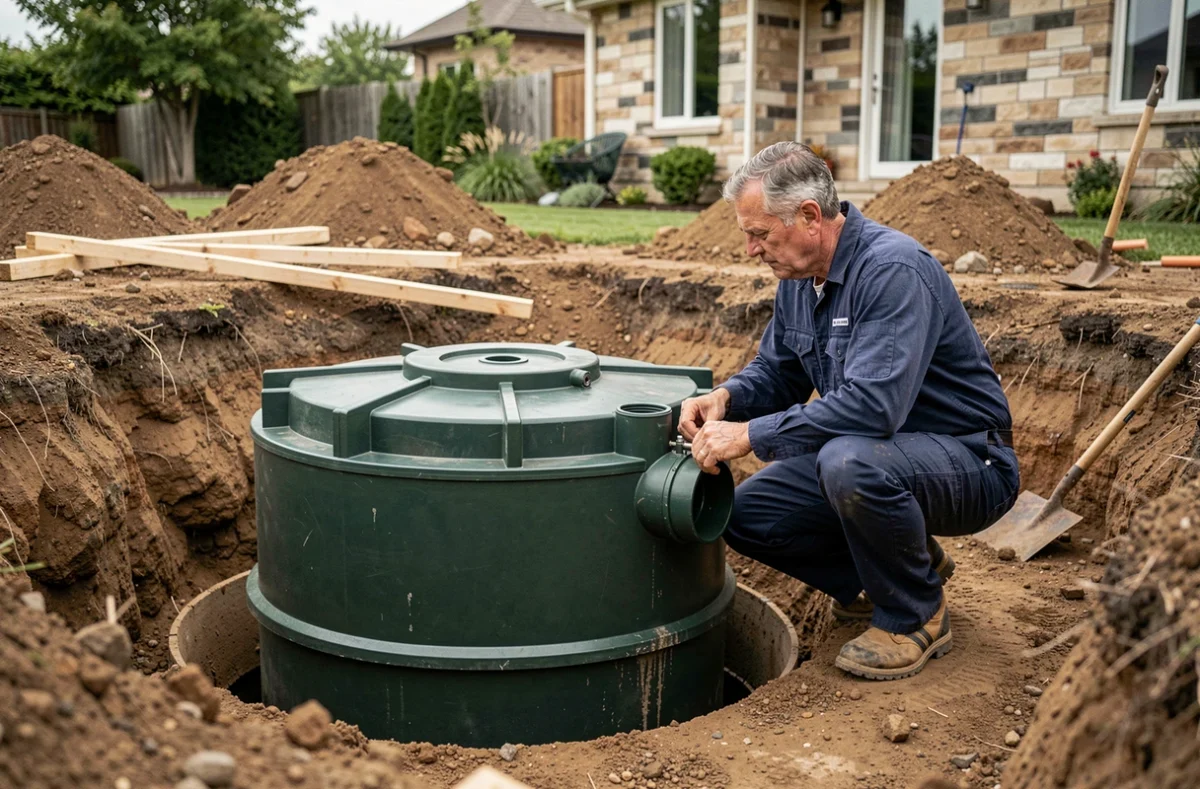
A four-bedroom house with a living room produces a daily volume of wastewater that most homeowners underestimate. When there is no connection to the public sewer system, the septic tank is the first stage of wastewater treatment.
The 3,000-litre model often appears in quotes, but this capacity is not suitable for every setup. Understanding what lies behind that figure can help you avoid installing a tank that is oversized—or, worse, too small to handle your household’s actual wastewater load.
Principal rooms and population equivalents: the calculation rule you need to know
Septic tank sizing is based on a specific concept: the principal room. Under French regulations, bedrooms and living rooms count as principal rooms. A house with a living room and four bedrooms therefore has five principal rooms.
For a home with up to five principal rooms, the minimum regulatory capacity is 3 m³, or 3,000 litres. Above that, each additional bedroom adds 1 m³ to the required capacity. A home with six principal rooms therefore needs a minimum capacity of 4,000 litres.
Why count rooms rather than the actual number of occupants? Because household size changes over time. A couple may have children or host relatives. Calculating capacity based on principal rooms accounts for these changes without requiring modifications to the system whenever the household changes. If you’re considering buying a 3,000-litre septic tank, first check that your home has no more than five principal rooms.
There is one exception: if the actual number of occupants is clearly higher than the number of principal rooms—for example, in a holiday rental or shared house—the SPANC may require a larger capacity.
Soil, groundwater and plot size: what capacity alone doesn’t tell you
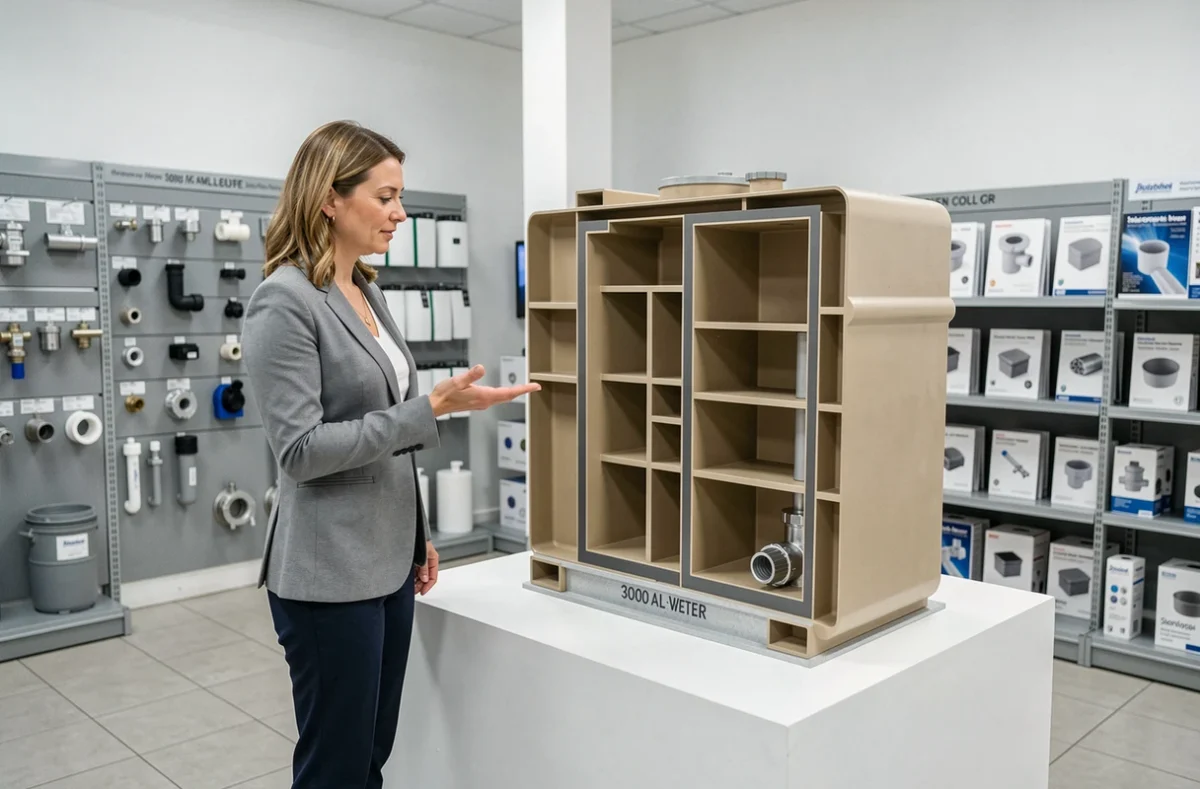
Choosing the right tank capacity isn’t enough. The ground where it will be installed determines the entire wastewater treatment system. Two homeowners with the same five-room house may need very different solutions depending on their soil.
Soil permeability and groundwater depth
For a conventional drainage field to work, the soil must allow water to pass through at a rate of 15 to 500 mm/h, across a layer at least 0.70 m thick. The groundwater table must be at least one metre below the bottom of the excavation. If these conditions are not met, a drainage field is not an option, even if the tank is perfectly sized.
In that case, other systems can be used, such as a compact filter, a package treatment plant or a raised infiltration mound. The right choice depends on the results of the soil survey.
Get a soil survey before buying a septic tank
A soil survey is not automatically required nationwide, but your local SPANC (Public Service for Non-Collective Sanitation) may require one. Check your local service regulations before ordering anything. Buying a 3,000-litre tank only to discover that the site requires a package treatment plant can lead to avoidable extra costs.
Check the following before settling on a capacity:
- Soil permeability, measured using a percolation test carried out by a geotechnical consultancy
- Groundwater depth, which varies by season and geographical area
- The space available on the plot for the treatment system (drainage field, compact filter or infiltration mound)
- Local SPANC requirements, which may mandate specific systems regardless of the tank’s capacity
3,000-litre septic tank: concrete or plastic? A choice that affects installation
The tank material has a direct impact on the installation work. The two common options are concrete and polyethylene (plastic).
A 3,000-litre concrete tank weighs several tonnes and requires lifting equipment for installation. It withstands soil pressure well and is unlikely to float if the groundwater level is high. However, transport and handling increase installation costs, especially when access to the site is restricted.
A plastic tank is much lighter, making it easier to transport and install. Its main drawback is that in waterlogged ground, buoyancy can push it upwards unless it is properly ballasted or anchored. This is a particular risk in areas with high groundwater levels or clay soils that retain rainwater.
The choice of material therefore depends on the soil, not just the budget. A plastic tank that costs less to buy may end up costing more if ballasting or anchoring proves complicated.
Emptying and maintenance: sludge depth is the only reliable indicator
Many homeowners think the tank needs to be emptied every four years. This is an average, not a hard-and-fast rule. Regulations require emptying before sludge exceeds half the tank’s usable capacity.
In practice, the schedule depends on how the home is used. A house occupied by two people accumulates sludge much more slowly than one occupied by a family of five. A second home used for just a few weeks a year may go much longer between emptying visits.
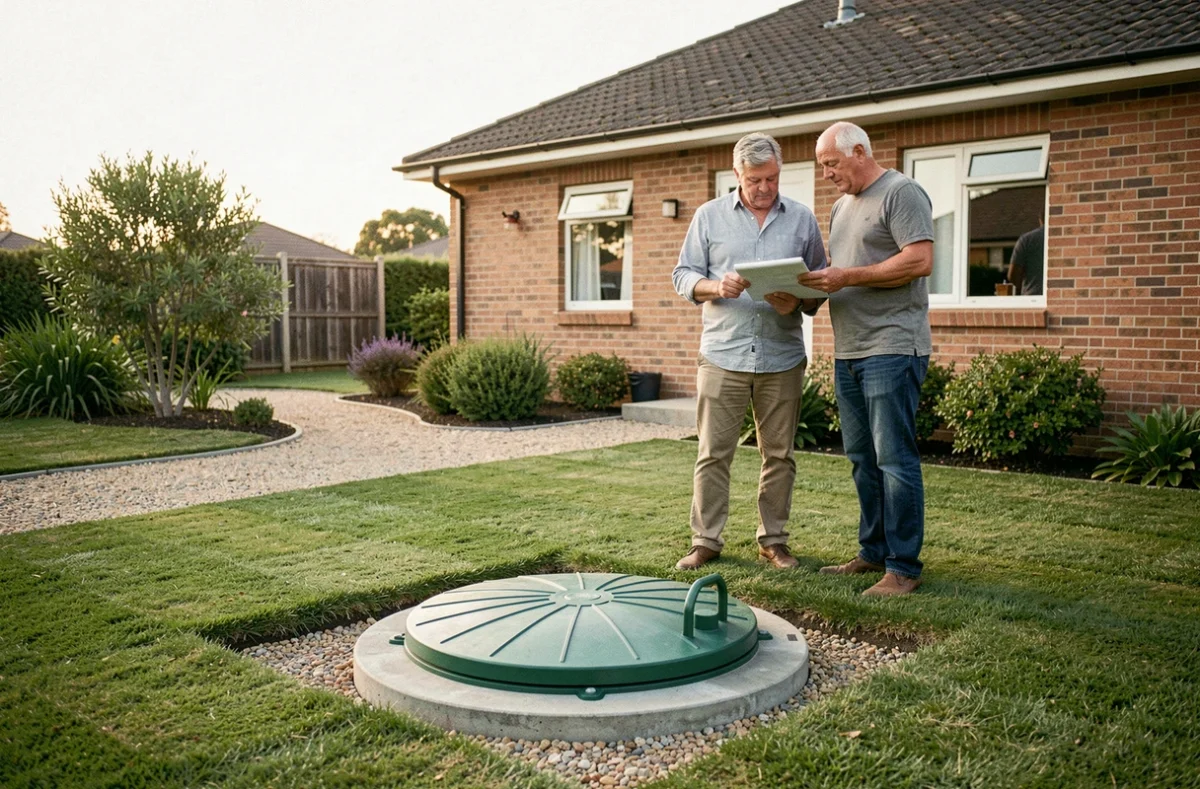
How can you monitor the sludge level? During the SPANC’s periodic inspection, the technician measures the sludge depth. Between inspections, an accessible inspection cover allows you to check the level visually. Failing to monitor it can lead to blockages in the downstream treatment system, which cost considerably more to fix than preventive emptying.
- Have the sludge depth measured at every SPANC inspection
- Never use harsh chemicals (large amounts of bleach or industrial drain cleaners), as they destroy the bacteria in the tank
- Keep the emptying certificate: it will be requested during a compliance inspection or if you sell the property
A 3,000-litre tank provides a comfortable margin for a standard-sized household. For a home with five principal rooms on permeable soil and with a sufficiently low groundwater table, this capacity meets regulatory requirements without unnecessary extra costs. The key question is never just the tank’s capacity, but whether that capacity is compatible with the soil and the chosen treatment system.