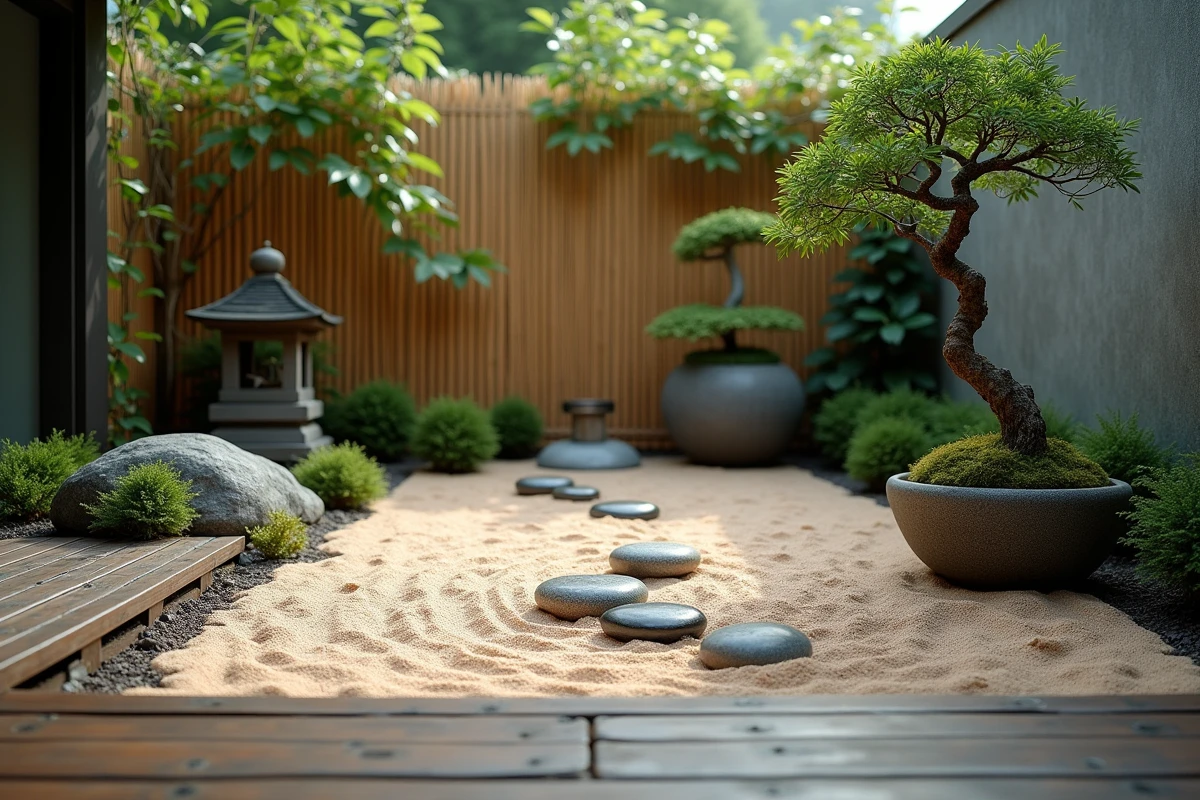
A three-square-meter balcony filled with mismatched pots, a strip of land along a party wall, a back garden where no one goes: it is often from these forgotten spaces that the best zen gardens emerge. The principle is based on a simple constraint: to create a place of calm with few elements, each chosen for its specific function.
Zen garden in a small space: start from the ground, not the decor
We almost always start by buying a statue or a lantern. This is the most common mistake. A zen garden is first built from the ground, as it sets the visual rhythm and determines maintenance.
Light gravel (white, pearl gray) laid on a geotextile mat forms the base. It is raked into curved or parallel lines to resemble water. This raking gesture is not trivial: raking the gravel becomes a daily meditative ritual, not a chore. In just a few minutes, one redraws the patterns and refocuses their attention.
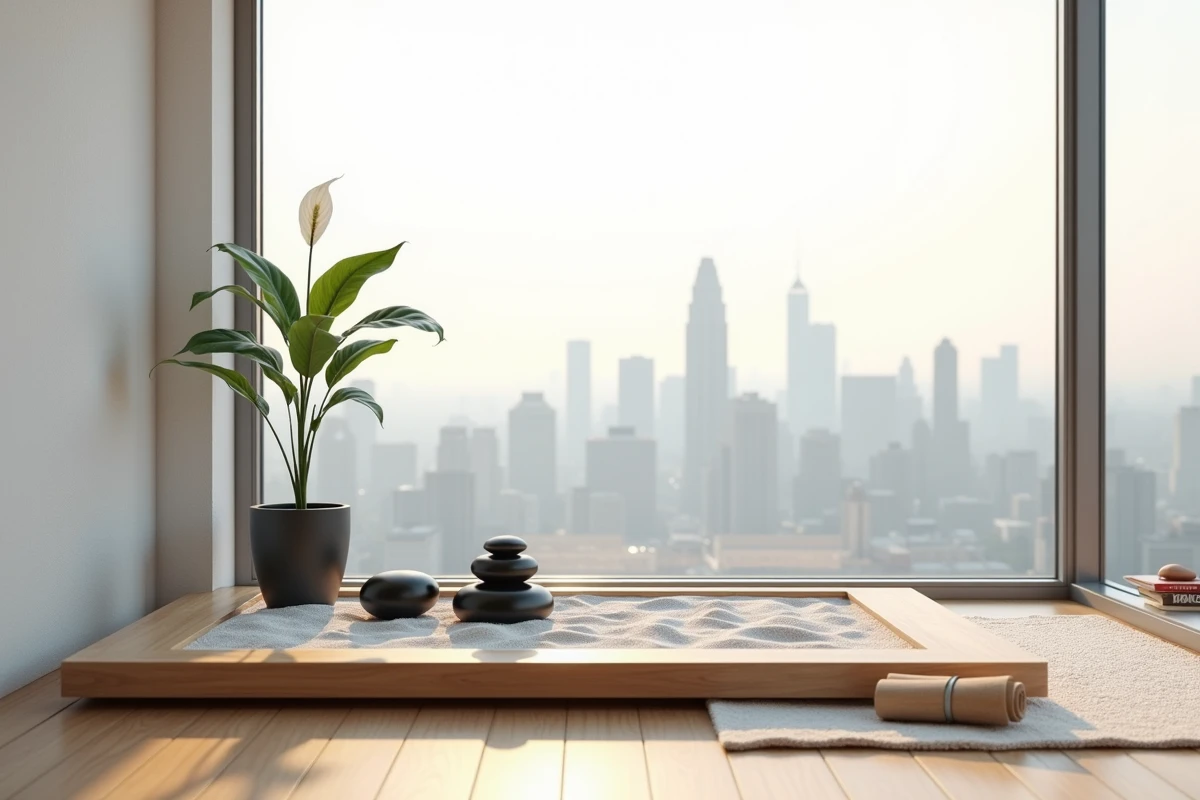
On a hard surface (concrete slab, terrace), one can work with shallow containers filled with gravel and polished pebbles. Three pebbles of different sizes arranged in an asymmetrical triangle are enough to anchor the composition. Asymmetry is the fundamental principle of the zen garden: it replicates natural forms and avoids the “store display” effect.
For those who wish to delve deeper into the choice of materials and suitable plants, Jardin Jade’s garden offers concrete ideas for structuring a coherent outdoor space.
Plants for a zen garden: choose based on function, not aesthetics
The temptation is to plant a Japanese maple because you’ve seen it in a photo. But if your space is south-facing with a calcareous soil, the maple will suffer and the garden will lose its serene character by the first summer.
Each plant must correspond to a specific function in the composition. Three roles are distinguished:
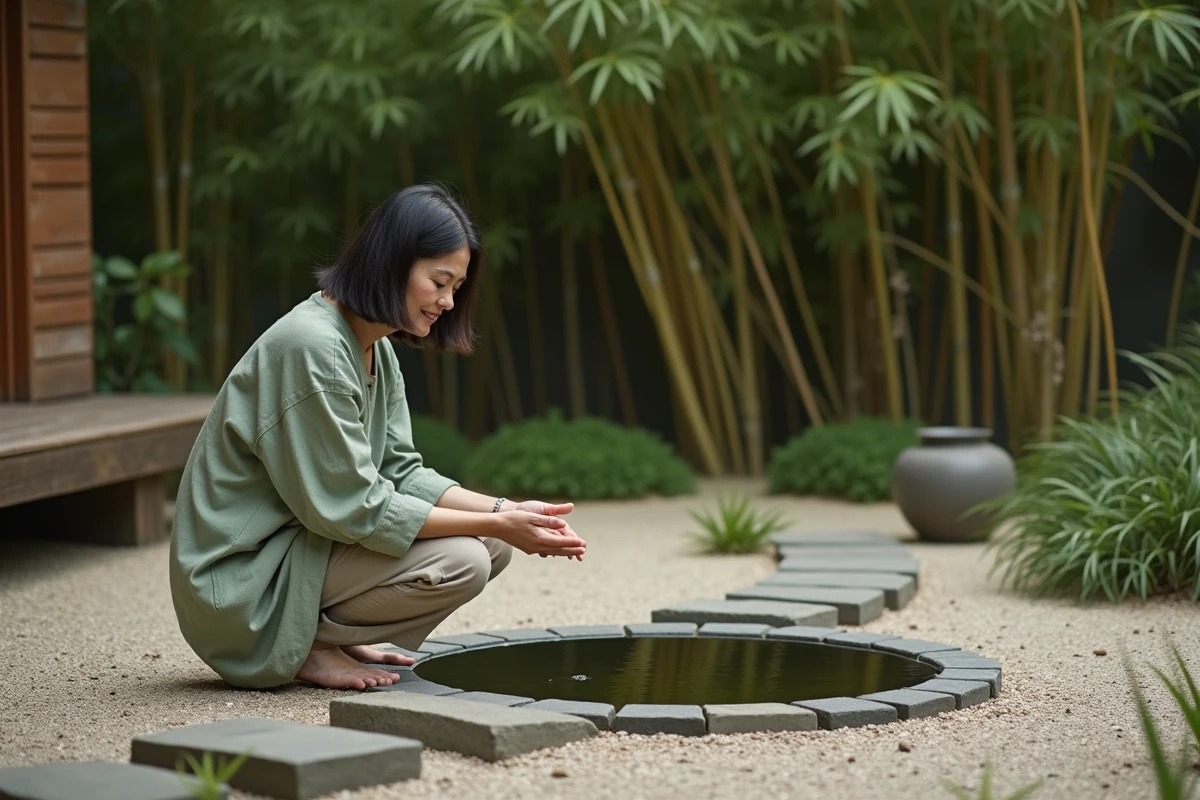
- Structural plants (container bamboo, pruned pine in niwaki, boxwood) that create verticality and visual screens. Bamboo in a rectangular planter forms a natural curtain that isolates from the neighbors without a rigid fence.
- Ground covers (moss, helxine, sagina) that dress the base of the rocks and soften the transition between mineral and plant. Moss grows well in the shade and tolerates moderate watering.
- Accent plants (fern, hosta, Japanese iris) that add a touch of color without overwhelming the whole. One or two are placed, no more.
Feedback varies on the hardiness of potted bamboo depending on the regions, but a sufficiently deep container with proper drainage limits problems in most cases.
Water and lighting in a zen garden: two elements that change everything
Water does not need to be abundant. A small stone pond with a circulating solar pump, a shishi-odoshi (bamboo fountain) or even a simple basin filled with clear water is sufficient. The sound of flowing water creates the zen atmosphere far more than any decorative object.
The solar pump is the simplest solution to install: no electrical connection, no trenching. It is placed in the pond, the panel nearby, and the circuit starts as soon as the sun shines. Maintenance is limited to cleaning the filter and checking the water level.
Discreet lighting to extend the garden in the evening
The lighting of a zen garden does not resemble that of a reception terrace. We seek low, diffuse sources that cast shadows on the gravel and highlight the texture of the rocks.
Recessed lights at ground level or solar stone lanterns placed next to key elements (main rock, pond, base of a bamboo) create a chiaroscuro effect that prolongs contemplation after sunset. String lights and spotlights are avoided, as they break the minimalist atmosphere.
Circulation and zones in a zen garden: the path matters as much as the destination
A successful zen garden is not a static tableau. It is a space where one moves slowly, where each step is intentional. Japanese steps (flat stone slabs spaced irregularly) naturally impose a slowed walking rhythm.
They are placed directly on the gravel or moss, slightly offsetting each slab to avoid a straight line. The curved layout forces the gaze to sweep across the entire garden instead of rushing to the back.
If space allows, three functional zones can be distinguished:
- A contemplation zone, with a simple bench or a flat stone to sit facing the focal point (rock, pond, plant composition).
- A transition zone, which separates the inside of the house from the zen garden itself. A simple change in flooring (wood to gravel, for example) marks this boundary.
- A back zone, often a plant screen (bamboo, trimmed hedge) that closes the perspective and visually isolates from external elements.
This organization into three zones works just as well on ten square meters as on a larger area. The difference lies in the scale of the elements, not in the principle.
A zen garden does not need to be finished to function. Adding one element per season, observing how it integrates, adjusting the arrangement of stones or the size of a shrub: this slow progression is part of the process. The most harmonious garden is the one that has had time to find its balance.